The $7 Watch With the $80 Story: How Social-Ad Watch Brands Work
The watch in the ad usually exists twice: once on a wholesale catalogue for a dollar or two, and once on a storefront with a founder story, a crossed-out price, and a countdown timer. The object is the same. Everything you are actually being charged for is the story.
PUBLISHED 2026-08 · REVISED —
At a glance
- Reverse-image-search the product photo before anything else — the documented cases trace straight back to $1–$5 wholesale listings, sometimes under several different “brand” names at once.
- Treat “free — just pay shipping” as a price tag: the shipping charge is the price, set above the cost of the watch itself.
- Ignore the crossed-out compare-at figure; in the documented teardown it was attached to a watch that never sold at that number anywhere.
- Ask one question of any watch listing: does it name its movement? A named calibre has a published spec sheet. “Premium movement” has nothing.
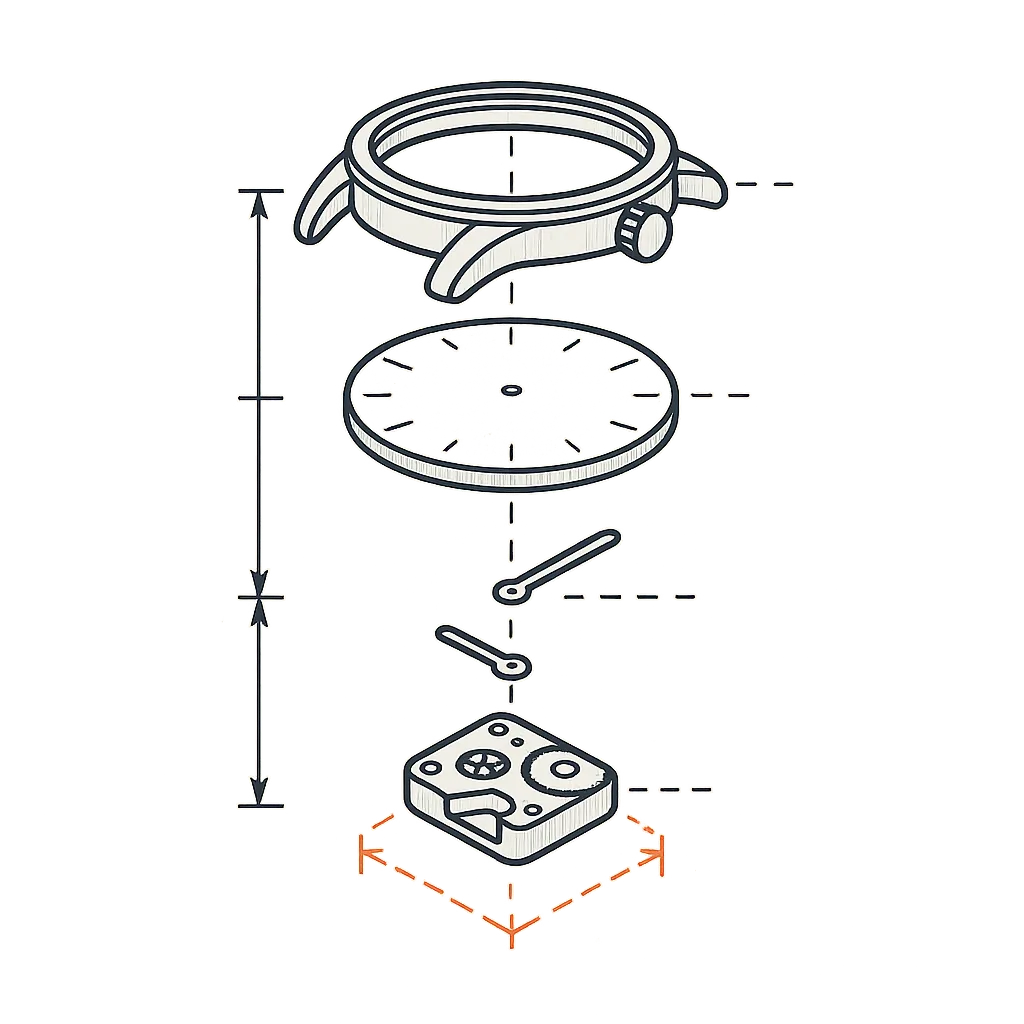
In 2017, a visitor handed the Museum of Capitalism a wristwatch. It had arrived as a “free” offer from an Instagram brand calling itself Folsom & Co., a “watch startup” supposedly based in San Francisco — free, that is, with $7 shipping. The artist and writer Jenny Odell traced the object backwards, and her investigation remains the clearest public dissection of how this genre of brand works. On the storefront, the watch carried a value of $29.99, crossed out and replaced with $0.00 beneath a countdown timer that restarted for every visitor. Comparable watches on the wholesale platforms it came from listed at between $1 and $5. The $7 shipping fee was not a shipping fee. It was the price, plus margin, for an object whose whole cost sat well under it.
Nothing about that arithmetic is unique to one shop, one platform, or one decade. The same funnel sells the same catalogue watches today under different names, and it is worth understanding as a machine — because every stage of it leaves a fingerprint you can check in under a minute.
01The funnel, from ad to unboxing
The model is dropshipping with a costume on. A wholesale marketplace supplies the object; a hosted storefront supplies the shop; a social platform supplies the audience. Alexis Madrigal, investigating the same ecosystem for The Atlantic in 2018 (in a piece flagged by designer Andrew Sleigh), described how cheaply the pieces snap together: a turnkey Shopify storefront, ads targeted by the platform, and identical product photographs reused across interchangeable brands. No stock is held. The “brand” is whatever the template's About page says it is.
What Odell's teardown shows is how little effort the costume requires. Folsom & Co. presented itself with a photograph implied to be its SoMa offices; the photo was of SPiN, a ping-pong social club. Its neighbourhood description — “home to web gurus, urban warriors, offbeat artists” — was copied verbatim from the neighbourhoods section of a San Francisco tourism site. It advertised a $1,500 student scholarship whose text was pasted from a real programme run by an unrelated watch marketplace, with no evidence any scholarship existed. And it was not one shop: the same watch Odell examined was sold as “The Jones” by Folsom & Co. of San Francisco, “The Elite” by a near-identical site claiming Miami Beach, and “The Ron” — at $53 — by a third claiming London. All of them ran the same free store template, default font untouched. All of them paid for WHOIS privacy so the registration trail went nowhere.
Red flag Urgency furniture that never resolves: countdown timers that reset on every visit, “only a few left” banners, five-per-customer limits on a free item, and purchase pop-ups (“someone just bought this watch!”) that — in the documented case — fired only while the window was in focus or being scrolled. These are theatre props, and they are the same props our scam-store field guide covers across every category.
The ad platform is not a vetting layer, and it is a mistake to read a sponsored post as an endorsement. Watch collectors on the WatchUSeek forum have documented Instagram running paid placements for sellers openly advertising counterfeit “Swiss clones” — and found the platform's reporting process arduous enough that flagging a single account meant answering a questionnaire about trademark ownership. If openly counterfeit goods clear the ad review, an invented brand selling a legal-but-anonymous catalogue watch clears it without friction.
02The compare-at price, and how to test it
The crossed-out figure is the funnel's load-bearing part. A $29.99 struck through to $0.00 reframes a $7 charge as a $30 gift; an $85 struck through to $19 reframes a catalogue watch as a bargain. The number costs nothing to type and is anchored to nothing. As Odell put it, the watch is $29.99 because someone said it's $29.99 — because a certain person is wearing it on Instagram. There is no reference market underneath the figure at all.
The test is a reverse image search, and it is the highest-value sixty seconds in this article. In Odell's investigation, one popular watch sold across these storefronts — “The Alpha”, black dial, gold lines, small rhinestones — traced straight to listings on Amazon, Alibaba and AliExpress at between $1 and $2. Her own watch was harder to trace, for an instructive reason: the product photo was itself a fake. It was the photograph of a ~$100 watch by Rosefield, a real Dutch brand stocked by department stores, with the logo edited out — advertising a watch that merely resembled the one that arrived. The same doctored image appeared across numerous wholesale suppliers' pages, sometimes with other invented, European-sounding brand names pasted onto the dial.
The claim
“RRP $85 — today only, FREE. Just pay shipping. Only 200 left!”
The fact
In the documented teardown, the “$29.99” watch existed on wholesale platforms at $1–$5, the free offer carried a $7 shipping charge exceeding the object's cost, and the countdown restarted for every visitor — Odell, There's No Such Thing as a Free Watch.
Two things follow from the arithmetic. First, “free plus shipping” is simply a price presented as not-a-price: a $12 shipping charge on a $2 object is a $12 watch, and one online commenter quoted in Odell's report explains the psychology plainly — people would rather pay $12 “shipping” for a free watch than $2 shipping for a $10 one. Second, the seller's incentives end at the moment of payment. A brand designed to be disposable has no reason to answer support email, honour a warranty, or exist next quarter. Before paying anyone, read the returns terms with the scepticism our returns guide recommends: with these storefronts, the practical answer to “can I return it?” is usually the price of finding out.
03What a movement name actually tells you
Here is the twist worth sitting with: the watch inside the funnel is usually not a fake in the mechanical sense. Under the dial of a typical fashion watch — honest or otherwise — sits a small, mass-produced quartz movement, and the movement itself is often a perfectly respectable machine. The deception is never the mechanism. It is the story wrapped around it, and the multiple of its cost you are asked to pay. Which is why the fastest way to judge any watch listing, at any price, is to ask what it names — because a named movement is a checkable claim, and this genre of brand names nothing.
A quartz movement keeps time electronically. A battery makes a tiny quartz crystal — cut, since Seiko's first production quartz watch in 1969, in the shape of a tuning fork — vibrate at a fixed frequency, today 32,768 times a second, and a circuit counts the vibrations and steps the motor once per second. That is why a quartz second hand ticks. It is also why quartz accuracy is quoted per month: Citizen's Miyota division, whose calibres power a vast share of the world's affordable watches, specifies its standard three-hand Cal. 2035 — in production since 1981 — at ±20 seconds per month, on a battery that lasts about three years. Nothing to wind, nothing to service beyond the battery.
An automatic (self-winding mechanical) movement keeps time with a spring. Your wrist's motion swings a weighted rotor that winds a mainspring; an escapement lets the stored energy out in even beats, typically 21,600 per hour in this price class, which is why the second hand glides in six small steps a second rather than ticking. Mechanical accuracy is quoted per day, and honestly wide: Seiko's own instruction booklet for its entry-level 4R35/4R36 automatics specifies a daily rate of +45 to −35 seconds, worn on the wrist between 5°C and 35°C, with a power reserve of about 41 hours. Citizen's Miyota 8215, the equivalent workhorse inside countless small brands, is specified at −20 to +40 seconds a day with roughly 42 hours of reserve. Set both against the quartz figure and the trade is stark: on timekeeping alone, the humble battery-powered module beats the far more expensive mechanical calibre by a factor of fifty or more.
So why would anyone choose the spring? Because the trade runs the other way in everything that is not accuracy. An automatic runs on motion instead of batteries, can be serviced more or less indefinitely, and carries the small daily ritual — wear it or wind it, or it stops inside two days — that makes mechanical watches an interest rather than an appliance. Quartz trades the romance for precision, a three-year battery, and shock-tolerance. Neither is the superior machine; they optimise for different things, and knowing which you are buying is the entire point of the movement line on a spec sheet. A listing that says only “premium movement” or “Japanese movement” without a calibre number is declining to make a checkable claim — which, from a brand that also declines to name its founder's real city, completes a pattern.
04What $50–$200 honestly buys
The strongest argument against the $80 story-watch is not thrift. It is that the same money, pointed at makers with published specifications, buys a startling amount of real watchmaking. The established names in this bracket — Seiko, Orient, Citizen, Timex, Casio — publish what their machines do and have serviced them for decades, and enthusiast guides such as The Modest Man's survey of automatics under $200 document how deep the field is, with the Seiko 5 line and the Orient Bambino as its standing landmarks.
Concretely, at the top of that range, a Seiko 5 Sports on the 4R36 calibre is a genuine automatic with hand-winding, hacking seconds, a day-date, roughly 41 hours of reserve and a stated 10-bar (100 m) water resistance — every line of it on Seiko's own product page rather than in an ad caption. Orient builds its own movements in-house at similar money. And at the bottom of the range, the anti-snob answer holds: a $30 Casio or Timex quartz, its accuracy quoted in seconds per month rather than per day, is a better timekeeping instrument than any mechanical watch on this page — and better at every measurable thing than the “$85” watch in the ad, which its own wholesale listing prices below your coffee.
Green flag The criteria that travel across brands: a named calibre; a stated crystal material (sapphire resists scratches best; mineral glass is normal and honest at this price); water resistance given in metres or bar, not adjectives; a warranty with a named duration; and a brand whose history survives a five-minute search that you did not start on their own About page.
05If one arrives anyway: what to check
Perhaps the watch is already on its way, or arrived as a gift. The inspection takes ten minutes. Compare the object against the ad photo first — in Odell's case the delivered watch differed visibly from the picture, in the texture of its band and the border of its face — and read the caseback, which on her example said “STAINLESS STEEL BACK” and nothing else: a caseback that names only its own material is a caseback with nothing to declare about the rest of the watch. Work the crown gently: set the time, and if there is a date, check that it changes near midnight rather than midday — a common assembly fault on carelessly cased watches. Then run the only test that matters: set it against your phone's clock and read it again in a week. A healthy quartz module should be within a second or two; minutes out means a defective or damaged movement. None of this makes a $2 watch worth $30 — but it tells you quickly whether it is even worth the drawer space, and it is the same object-first habit described in how we work: check the thing itself, not the story around it.
The checklist — before you tap the ad
- Reverse-image-search the product photo (Google Lens or TinEye), then search the wholesale marketplaces for it. If it surfaces at $1–$7 under other names, you have found the real price.
- Search the brand name plus “review” away from its own site and its own social accounts. Read the one-star reviews first.
- Look up the domain's registration date at lookup.icann.org. A heritage story on a months-old domain settles the question.
- Find the movement line. No named calibre, no purchase.
- Convert “free — just pay shipping” into a price: the shipping charge is what you are paying for the object. Decide if the object is worth it.
- Ignore the crossed-out price entirely; treat the charged amount as the only real number on the page.
- Read the returns policy before checkout, and assume a disposable brand will not be there to honour it.
Sources
- Jenny Odell / Museum of Capitalism — “There's No Such Thing as a Free Watch” (investigative report, 2017)
- Alexis Madrigal, The Atlantic — “The Strange Brands in Your Instagram Feed” (2018) — via Andrew Sleigh, Fake Brands and Free Watches
- WatchUSeek forums — Instagram Sponsors Counterfeit Watch Sellers
- Seiko Watch Corporation — Cal. 4R35/4R36 instruction booklet (accuracy and power-reserve specifications)
- Seiko Watch Corporation — Basic knowledge: quartz watches (1969 Quartz Astron, tuning-fork crystal)
- Seiko Watch Corporation — Seiko 5 Sports SRPD55 specifications
- Miyota (Citizen Watch Co.) — Cal. 2035 specifications
- Miyota (Citizen Watch Co.) — Cal. 8215 specifications
- The Modest Man — The Best Affordable Automatic Watch Under $200