“Genuine Leather” Is the Warning, Not the Promise: Handbag Leather Grades Explained
In leather's trade vocabulary, “genuine” names the lowest grade of real leather — the layers left over after the strong top surface has been split away, then sanded and stamped to look like what was removed. Shoppers read it as praise. It is closer to a confession.
PUBLISHED 2026-08 · REVISED —
At a glance
- Read the label as a ladder: full-grain at the top, then top-grain, then corrected grain, then “genuine leather” (split leather), then bonded scrap at the bottom.
- The highest-value test costs nothing: bend the leather gently and watch the crease — dense grain wrinkles fine and tight; coated splits crease coarsely or whiten.
- Read the cut edge: tight fibres in one continuous layer is a good sign; a visible sandwich of layers, or a spongy core under a smooth skin, is the grade talking.
- Perfectly even, endlessly repeating grain is embossed grain. Pores, small scars, and variation are what an intact hide surface looks like.
- The details that expose fake designer bags — stitches per inch, unfrayed thread, solid hardware, smooth zippers — grade every bag at every price.
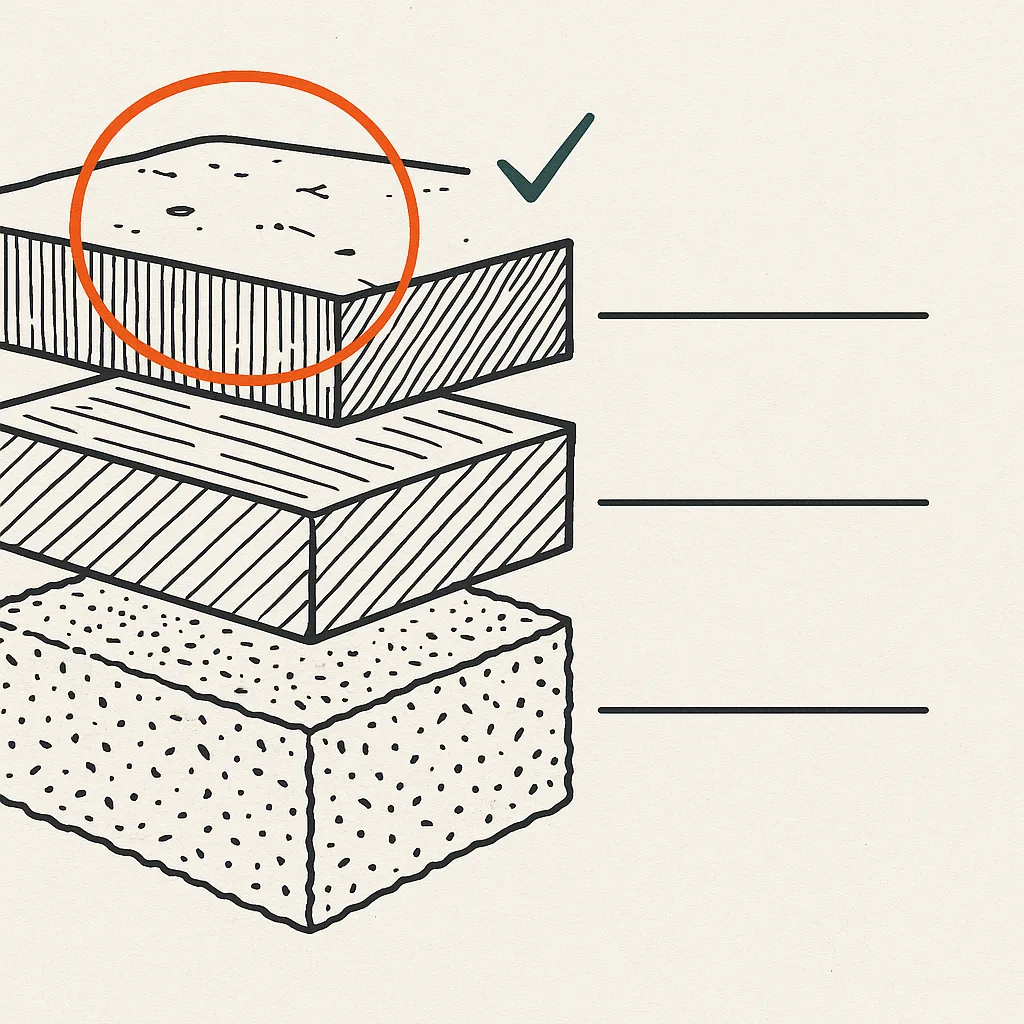
Few marketing phrases work as hard as “genuine leather”. It sounds like a guarantee — real, not fake, the good stuff. In the vocabulary of the leather trade it means nearly the opposite: it is the conventional name for the lowest grade of real leather. A tag that says “100% genuine leather” is telling the truth, the way a menu that says “food” is telling the truth. The word answers the question is it leather at all? and silently declines the question that actually matters: which part of the hide is it, and what was done to it?
That second question has a concrete, physical answer, because leather grades are not abstractions or quality scores. They describe a cross-section — where in the thickness of an animal hide a given piece was cut, and how much of its strongest layer survived the journey to the shop. Once you can picture the cross-section, the labels decode themselves, and a handful of hands-on tests let you check the label against the object in under a minute.
01The ladder is a cross-section
A cattle hide arrives at a tannery several millimetres thick — far too thick for a handbag panel — so it is split horizontally into layers, like slicing a cake. The layers are not equal. The top surface, where the hair grew, is called the grain: a thin stratum of tightly packed, vertically tangled protein fibres that spent the animal's life resisting weather, sun, and thorns. Everything beneath it is progressively looser and spongier — strong enough in bulk, but without the dense weave that makes the surface durable. Nearly the entire grade ladder is a description of how much of that top stratum a given piece kept.
Full-grain keeps all of it. The hide's surface is left untouched — pores, healed scratches, the occasional scar — because, as the American leather-goods maker Ezra Arthur puts it, that surface holds the densest, strongest fibres in the hide. Full-grain is the grade that patinas best: because the intact grain absorbs oils and light rather than sitting under a plastic finish, it darkens and softens with use instead of wearing out. It is also the most expensive grade, because only clean, well-raised hides look acceptable without cosmetic correction.
Top-grain is the same top cut with a compromise applied: the very surface is lightly sanded to remove marks and scars, then refinished. Most of the dense layer survives, so top-grain remains durable and is the workhorse of well-made bags — but the sanding takes the most weathered micro-surface off, so it ages politely rather than beautifully. It patinas less, and a heavier finish coat does more of the cosmetic work. Heavier versions of the same correction are sold as corrected grain: blemished hides sanded until the natural surface is largely gone, an artificial grain pattern embossed on with a heated plate, and a pigmented finish sealing the result. From a distance corrected grain photographs like the grades above it; up close it behaves like the finish, not the hide, because the finish is now doing most of the work.
“Genuine leather” — split leather, in honest trade language — is cut from the weaker layers that remain once the top grain is split away. Because their fibre structure is loose and uniform, the face is typically sanded smooth and stamped with an artificial grain, then frequently sealed under a heavy finish coat to fake the lustre of the layer it lost. Without the grain, it does not patina; it tends to crack or peel as the coating fails, instead of softening.
Bonded leather is the floor of the ladder, and barely on it: leather dust and offcuts glued together with polyurethane over a backing sheet, the material equivalent of chipboard. It is mostly not leather, and it wears out fast — the surface film delaminates and flakes, which is why a peeling “leather” sofa or belt so often turns out to be bonded stock wearing out on schedule. On a bag label it may hide behind phrases like “bonded”, “reconstituted”, or “leather blend”.
The claim
“Crafted from 100% genuine leather.”
The fact
“Genuine leather” is a grade, not a compliment: the cuts left after the strong top grain is split away, sanded and embossed with an imitation grain, prone to cracking and peeling rather than ageing (Ezra Arthur).
One caution before the ladder hardens into law: these are trade terms, used loosely and sometimes cynically. A tannery's “top-grain” may be another's “corrected”, and a listing that says only “real leather” has told you nothing about the cut at all. Which is exactly why the tests below matter more than the tag: the label can be optimistic, but the cross-section cannot lie.
02What the sanding takes away
It is fair to ask why any of this matters if the corrected and split grades look fine in the shop. The answer is mechanical, and the clearest description of it comes from Horween, the Chicago tannery whose leather ends up in some of the best shoes and goods made. Horween writes about a property called break: the physical and cosmetic character leather shows when its grain side is creased or folded back against itself. Good break means fine, tight creasing; poor break means coarse, loose wrinkles. Technically, the tannery notes, breaking is the de-lamination of the grain from the layers below — every fold flexes the bond between the dense surface and the softer corium underneath.
What produces good break, per the tannery, is density: a tannage that fills the fibre network into a durable, tight matrix, air drying that shrinks and consolidates the hide, and cuts from near the backbone, where the fibres are tightest. Notice what every item on that list has in common — it is all about the quality and density of the fibre structure itself. A split with a plastic-coated face has none of that structure where it counts. It cannot crease finely, because the surface doing the creasing is a plastic film over sponge; it can only fold coarsely, and eventually the film whitens, cracks, or peels at exactly the flex points a handbag uses most — the top edges, the strap anchors, the corners that touch the floor.
This is also why full-grain gets better looking with use while lower grades get worse. The intact grain responds to handling by compressing, polishing, and darkening — patina. A finish coat responds to handling by abrading. Two bags can leave the shop looking similar and be on opposite trajectories from the first day.
03The hands-on exam: bend, edge, grain, smell
None of these tests needs equipment, and the highest-value one comes first.
Bend it, and watch the wrinkle
Fold a soft, unstructured part of the bag gently — a gusset, a corner of the flap, the underside of a strap — grain side out, and watch what the surface does. Dense, intact grain wrinkles into fine, tight, shallow creases that relax when you let go; that is Horween's good break, visible to anyone. Corrected and split leathers crease coarsely, in a few large soft folds, and heavily coated surfaces may show a faint whitening line along the fold where the finish stresses. If the surface kinks like a plastic sheet, or nothing wrinkles at all because the face is a film, the label has been answered. Be reasonable about force — the test is a gentle flex, not an attempt to crack the bag in the shop.
Read the cut edge
Edges are where a bag stops performing, because they show the cross-section directly. Look at a strap edge or any cut, unfolded edge. Good leather shows dense fibre through its whole thickness, tightening toward the grain surface, usually finished with wax or paint but recognisably one continuous material. The warning signs: a visible sandwich — a thin surface skin sitting on an obviously different, fuzzy or spongy core — which is a coated split announcing itself; or an edge so perfectly uniform and smooth it could be extruded, which is what synthetics look like in section. Cheap construction hides edges for this reason, folding and gluing every one; a bag with no visible edge anywhere is not proof of anything, but it removes one of your best instruments.
Look for grain, scars, and repetition
Natural grain is a fingerprint: pore patterns that tighten and loosen across a panel, hairline surface variation, sometimes a healed scratch or an insect bite the tannery left in. Embossed grain is wallpaper — the same texture at the same depth everywhere, and on larger panels the pattern can visibly repeat, because it came off a plate. Perfect evenness reads as luxury to the eye and is usually the opposite: flawlessness at split-leather prices is achieved by sanding off the truth and stamping on a story. A small scar on a full-grain bag is the more honest signature.
Smell it
Leather's tannage gives it a distinct earthy, slightly sweet smell that synthetics have never convincingly copied. The RealReal — the resale house whose business depends on catching fakes — puts the contrast plainly in its authentication guidance: real leather smells earthy, while imitations tend to reek of chemicals and plastic. A strong solvent or vinyl smell from a “leather” bag is a red flag for either a synthetic or a heavily coated split drowned in finish. The same guidance notes a touch test worth pairing with it: real leather is soft and stretches a little under a fingertip, where fake leather feels plastic-like and does not give.
Run the four tests in that order — bend, edge, grain, smell — and they triangulate. Any single test can be fooled; a bag that passes all four is, whatever the tag says, made from the good part of the hide.
04What fake bags teach about every bag
There is a second vocabulary of quality worth learning from an unlikely curriculum: designer-bag authentication. The people who examine secondhand luxury bags for a living — resale authenticators like The RealReal's team — catch counterfeits on construction details, and the useful realisation for everyone else is that those details are not brand trivia. They are simply what careful manufacture looks like, which means the same checklist that exposes a fake at four figures grades an unbranded bag at two.
Stitching first, because thread is honest. Tight, even stitching requires better machines, better thread, and more time per bag, so it is one of the first corners cut at every quality level. Count stitches along an inch of a strap or seam: Luxe Paragon's authentication guide puts Louis Vuitton at a consistent 8–10 stitches per inch, with fakes typically showing 6–7 or a suspiciously crammed 11-plus. The exact number matters less than the pattern: on a quality bag the stitch length never varies, lines run straight, corners are crisp, and nothing is frayed. The RealReal's guidance says it directly — if the thread is frayed or the stitches are inconsistent, the alarm bells should begin to sound.
Then hardware, by weight. Pick up the bag and work every metal part. Quality hardware — buckles, feet, D-rings, clasps — is solid metal: it feels substantial and heavy for its size, and its engravings are deep and precise, with sharp edges. Counterfeit and cheap hardware is cast from lightweight zinc alloy that feels hollow, its stampings shallow and soft-edged — and, The RealReal's guidance again, it fades, chips, or rusts with use where the durable original will not. Hollow hardware is not merely cosmetic: it is where straps tear free, because the metal deforms before the leather does.
Red flag A zipper that sticks, binds, or needs a wiggle at the corners on day one. Zip action is a one-second proxy for the whole bag: authentic, well-made zippers run smoothly with no resistance, and a maker who fitted a grinding zipper made the same decision everywhere you cannot see.
Then the interior, where budgets go to die. Linings sewn straight and taut rather than bagging loose; interior pockets that are actually finished inside; seam allowances that do not shed threads; the same stitch quality on the underside of the flap as on the front. Makers spend where buyers look. A maker who spent where buyers do not look was not cutting corners anywhere.
None of this requires a logo to be useful. Grade the leather with Section 03, then grade the construction with this section, and price becomes the last fact you check rather than the first — which is the correct order, since a high price guarantees nothing and a low one merely tells you where the compromises must be hiding. The RealReal's authenticators make the related point about deals: when a price significantly undercuts the typical one, authenticity — and by extension quality — is exactly what should come under suspicion.
05Judging leather through a screen
Online, three of the four hands-on tests are unavailable, so the exam shifts to photographs and language. Zoom on the product photos: you are looking for visible grain variation across panels, edge close-ups (their absence in a large photo set is itself informative), stitch lines sharp enough to count, and hardware shot close enough to judge the engraving. Renders and heavily retouched images that show a perfectly even texture everywhere are answering the repetition test for you.
Then read the materials line like a contract, because it is written like one. “Full-grain leather” is a specific claim a seller can be held to. “Genuine leather” is the bottom rung wearing its Sunday name. “Vegan leather” and “PU leather” are plastics, stated almost honestly. And an expensive-looking bag whose listing says only “premium materials” has chosen not to make a claim at all — treat the silence as the answer. The same read-the-listing discipline applies to the store itself; the guide to spotting a scam online store covers the shop-level tells.
Whichever grade you end up buying — and there are perfectly good reasons to buy a coated split at a coated-split price, provided you knew that was the deal — the leather's finish determines how it should be cleaned and fed, which is covered in the handbag care guide. The sourcing rule behind the leather science on this page is the usual one: tanneries and makers over marketing copy — with resale authenticators consulted for the counterfeit-spotting details.
The checklist
- Translate the label before anything else: full-grain, then top-grain, then corrected, then “genuine” (split), then bonded — and treat “genuine leather” as a disclosure, not a boast.
- Bend a soft panel gently, grain side out: fine tight wrinkles pass; coarse folds, whitening, or a plastic kink fail.
- Find a cut edge and read the cross-section: continuous dense fibre passes; a skin-on-sponge sandwich or an extruded-smooth edge fails.
- Scan the grain across large panels: pores, variation, and the odd scar pass; wallpaper-perfect texture that repeats is embossed.
- Smell it: earthy passes; solvent or vinyl fails.
- Count stitches on an inch of seam — roughly 8–10 even stitches passes; under 8, uneven lengths, or frayed thread fails.
- Weigh the hardware in your hand and run every zip: solid, heavy, crisp, and smooth passes; hollow, soft-edged, or grinding fails.
- Buying online, demand the photos do this work: edge shots, countable stitches, close hardware — and read “genuine leather” in the listing exactly as you now would on a tag.
Sources